Value Proposition
The 10-Year Micro-Retirement Cycle: A New Pension Framework
By Almaz Ruslan, Finspire Technologies LLC, 14 November 2025
1. Executive Summary
2. The Global Retirement Gap for Mobile and Low-Income Workers
1. Structural Pension Exclusion
2. Expatriates and Migrant Workforce Dynamics
3. SMEs and the Cost Barrier
3. Limitations of Existing Micro-Pension Models Worldwide
4. The 10-Year Micro-Retirement Cycle: Concept Overview
1. Definition
2. Why 10 Years?
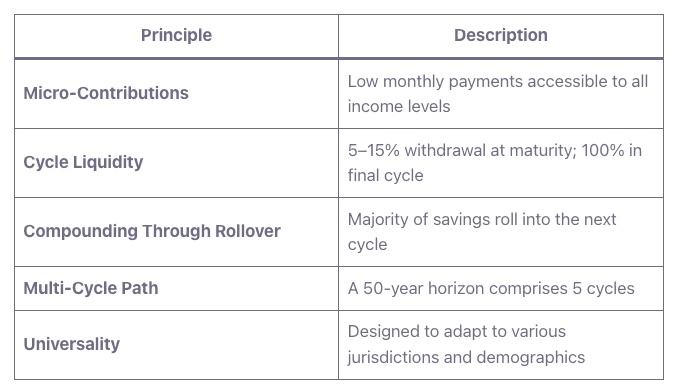
3. Cycle Architecture and Core Principles
5. Cycle Mechanics: How the Model Works
1. Accumulation Phase
2. Investment Growth
3. Liquidity Window
4. Multi-Cycle Compounding
6. Financial Simulation: A 50-Year Multi-Cycle Projection
1. Assumptions
2. Cycle-by-Cycle Simulation Table
3. Key Insights
7. Ethical & Shariah-Compatible Investment Architecture
8. Conceptual Portability and Global Applicability
1. Portability as a Design Principle
2. Adaptability Across Jurisdictions
9. Comparative Analysis: Global Micro-Pension Benchmarks
10. Innovation Positioning: A New Pension Framework for the Next Gen Workforce
11. Intellectual Property and Novelty Statement
12. Conclusion
Executive Summary
The structure of work is evolving faster than traditional pension systems can adapt. Hundreds of millions of people, particularly expatriates, migrant workers, informal laborers, and employees of small to medium-sized enterprises remain excluded from long-term retirement planning. The majority of global pension architectures were built for a world that assumed lifelong employment, geographical permanence, and employer-sponsored benefits.
Finspire Technologies proposes a globally innovative framework: The 10-Year Micro-Retirement Cycle, a structured retirement planning model that empowers individuals to accumulate wealth through small, recurring contributions; benefit from professionally managed, and access a portion of their savings at predictable 10-year intervals.
This framework reimagines retirement as a sequence of accessible, repeatable cycles, rather than a single, inaccessible, distant event. It blends financial inclusion, long-term investment discipline, solving longevity risk, and realistic liquidity needs of modern workers into one coherent model.
The 10-Year Micro-Retirement Cycle is a new pension framework designed for a global workforce characterized by mobility, income variability, and limited access to traditional pension systems.
The Global Retirement Gap for Mobile and Low-Income Workers
Structural Pension Exclusion
Traditional pension systems assume:
Long-term employment
Fixed employer-employee structures
Stable residency
Lifetime contributions to a national or corporate system
This excludes:
Migrant workers
Expatriates
Contract-based workers
Gig economy participants
Low-income households
Workers in informal sectors
Today, more than 2 billion workers globally lack access to a structured pension system.
Expatriates and Migrant Workforce Dynamics
Across global labor markets, including the GCC, Southeast Asia, and Europe, expatriates and migrant workers often:
Change employers frequently
Move across borders
Are excluded from national pension systems of the residing country
Lack employer-sponsored schemes or model
Earn incomes that make traditional pension contributions infeasible
These workers need flexible, micro-based, mobile-friendly retirement mechanisms.
SMEs and the Cost Barrier
SMEs dominate global economies, representing:
90%+ of businesses
50–70% of employment
Limited financial capacity for formal pension schemes
SMEs require:
Voluntary, low-commitment contribution models
No actuarial liabilities
Simple, technology-enabled retirement solutions
These limitations hinder universal pension inclusion.
Limitations of Existing Micro-Pension Models Worldwide
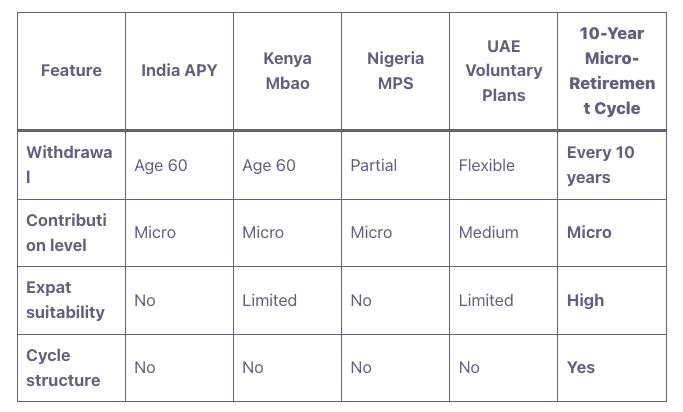
Countries such as India (APY), Kenya (Mbao), and Nigeria (Micro Pension Scheme) pioneered micro-contribution systems. However, globally they share these weaknesses:
Withdrawals restricted until age 55–65 due to following the retirement age policy
No cycle-based structured access window for early withdrawals
Not designed for mobile expatriate populations
Rigid structures requiring long-term continuity
Dependence on government or statutory frameworks
The world still lacks a so called “micro-pension” framework that blends flexibility, liquidity, micro-contribution affordability, and multi-cycle compounding.
The 10-Year Micro-Retirement Cycle: Concept Overview
Definition
The 10-Year Micro-Retirement Cycle is a structured retirement framework where individuals:
contribute small monthly amounts
invest with different risk portfolios for every 10 years cycle
access part of their accumulated savings every 10 years
flexibility to roll the remaining balance into the next cycle
build long-term retirement wealth across multiple cycles
It transforms retirement from a distant milestone into a series of predictable liquidity intervals.
Why 10 Years?
A decade is the ideal time horizon for:
Meaningful investment compounding potential, reducing investment risk
Predictable liquidity planning to access at 10-year intervals
Life-stage financial needs and planning
Global workforce mobility for shorter cycle option
Affordable contribution patterns per cycle
Shorter than 10 years hinder growth; longer than that reduces accessibility.
Ten years is the optimal global benchmark.
Cycle Architecture and Core Principles
Cycle Mechanics: How the Model Works
Accumulation Phase
Users deposit affordable monthly contributions over 10 years, adapting contributions to income variability.
Investment Growth
Funds are professionally managed by licensed asset managers using diversified, regulated portfolios.
Liquidity Window
At cycle maturity, users have the option to access part of the fund with a pre-set percentage (recommended between 5–15% before full maturity).
Multi-Cycle Compounding
Remaining balances automatically roll into the next cycle, accelerating long-term wealth accumulation.
Financial Simulation: A 50-Year Multi-Cycle Projection
Assumptions
Monthly Contribution: $ 250 (or equivalent)
Cycles: 5 (50 years)
Annual Returns: 10%, 8%, 8%, 6%, 6%
Withdrawal at cycle maturity: 5%, 7%, 10%, 15%, 100%
Cycle-by-Cycle Simulation Table

Key Insights
$ 250/month → $ 1,023,715 after 50 years
Total contribution: $ 150,000
Compounding gain: $ ~875,000
Liquidity across cycles maintains engagement
Cycle rollover is the main engine of exponential growth
Ethical & Shariah-Compatible Investment Architecture
While this framework is globally adaptable and not inherently tied to any faith-based system, it is compatible with ethical and Shariah-aligned investing principles commonly found in other established Islamic Finance markets.
Investment partners may adopt:
ethical screening
non-speculative structures
diversified regulated portfolios
This ensures the model can operate in both Islamic and conventional financial markets.
To seek guidance from examples below:
AAOIFI (Accounting and Auditing Organization for Islamic Financial Institutions)
IFSB (Islamic Financial Services Board)
National Shariah governance frameworks (Malaysia, Indonesia, GCC)
Conceptual Portability and Global Applicability
Portability as a Design Principle
The cycle model is designed to function independently of geography. Portability is conceptual and depends on:
local laws
financial institution rules
residency and KYC requirements
regulatory cross-border permissions
Adaptability Across Jurisdictions
The model can be implemented by:
pension providers
Islamic fund managers
digital wealth platforms
SMEs offering employee benefits
governments seeking inclusive retirement frameworks
Comparative Analysis: Global Micro-Pension Benchmarks
Innovation Positioning: A New Pension Framework for the Next Gen Workforce
The 10-Year Micro-Retirement Cycle represents a shift from:
rigid to flexible
inaccessible to inclusive
employer-driven to individual-driven
deferred retirement to phased retirement
one-off pension payout to multi-cycle planning
It is the first retirement model designed for:
global mobility
low-income earners
Islamic finance markets
digital-first ecosystems
SMEs seeking low-cost benefits
This framework can serve as a blueprint for pension innovation globally.
Intellectual Property and Novelty Statement
Finspire Technologies LLC asserts that:
The 10-Year Micro-Retirement Cycle is an original conceptual framework
No global pension model uses decade-based structured liquidity cycles
No micro-pension system integrates micro-contributions, multi-cycle compounding, and cycle-based portfolio risk with optional portability
The terminology, structure, diagrams, and methodology are proprietary
This white paper forms part of the intellectual record establishing Finspire’s authorship.
Conclusion
The 10-Year Micro-Retirement Cycle addresses a global need: a retirement model aligned with the realities of the modern workforce.
It provides an innovative, globally adaptable pension framework for the modern workforce. By combining micro-contributions, predictable 10-year access windows, regulated investment growth, and multi-cycle compounding, redefining retirement for populations historically excluded from pension systems.
It is a globally relevant pension framework, simple enough for individuals, flexible enough for SMEs, and powerful enough to reshape retirement inclusion worldwide.
It is practical, globally relevant pension framework, and forward-looking, designed to address one of the world’s largest socioeconomic challenges: increasing longevity, inclusive, and sustainable retirement readiness.